As someone who’s been exploring plant-based options for a while, I love the idea of cruelty-free and sustainable eating. But the more I dig into the science behind vegan alternatives, the more I wonder—are these foods as natural as they seem, or are they just as engineered as lab-grown meat and GMO products?
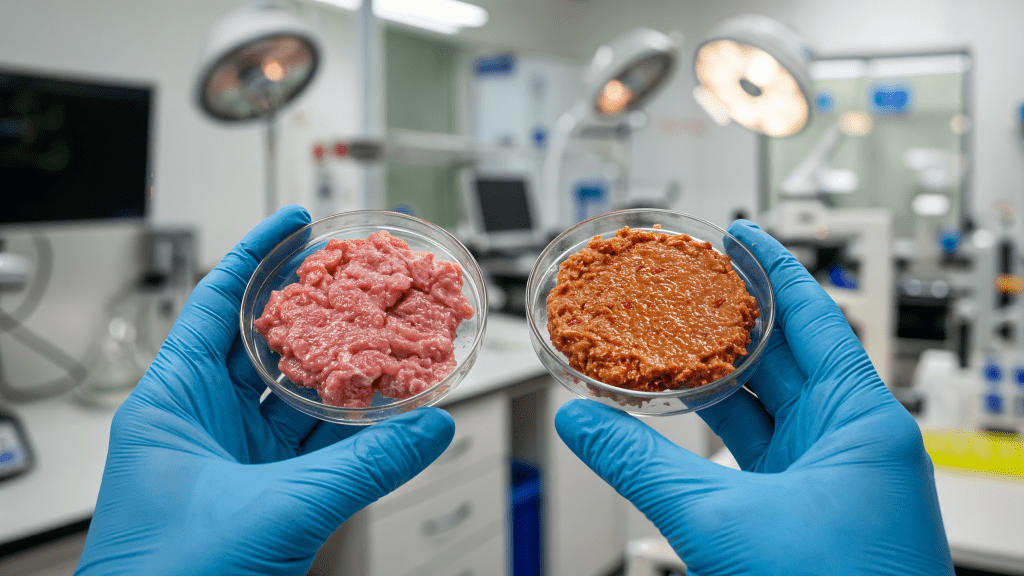
The Science Behind Vegan Alternatives
I used to think that vegan food substitutes were made from simple, wholesome ingredients. But it turns out, there’s a lot of technology involved in getting plant-based foods to look, taste, and feel like animal products. Many vegan meats and dairy alternatives come from soy, peas, and other legumes. Their proteins are extracted, isolated, and processed to create textures similar to meat or dairy. High-pressure extrusion techniques transform these plant proteins into a fibrous, meat-like structure. Some companies also use microbial fermentation to make proteins and fats that mimic those found in dairy and eggs. Coconut oil, shea butter, and sunflower oil often enhance the creamy, fatty mouthfeel of cheese and meats. Have you ever noticed how some plant-based burgers taste meaty? Thanks to yeast extracts, spices, and natural flavours that create replicated tastes similar to animal foods.
Are These Foods Different From GMO and Lab-Grown Products?
The more I read, the more I see some striking similarities between plant-based alternatives and other food technologies like GMOs and lab-grown meats.
- Genetic Modification: Some plant-based foods contain genetically modified ingredients, especially soy or corn-based products. And those without, are starting to use precision fermentation and bioengineering to improve taste and texture.
- Lab-Grown Parallels: Lab-grown meat is made by growing real animal cells in a controlled environment with no slaughter necessary. While vegan alternatives don’t use animal cells, they go through heavy processing, just like cultivated meat does.
- Highly Processed Reality: I used to think vegan meats were just plants, but honestly, some products are so processed that they barely resemble their original ingredients. Impossible Burgers and Beyond Meat go through multiple steps of extraction, heating, and reformation similar to cultivated meat grown in labs.
Are Vegan Alternatives Truly “Natural”?
If you’re looking for a minimally processed way to eat plant-based, sticking to whole foods is probably best. Jackfruit, mushrooms, lentils, and tofu are great meat alternatives that are not processed. But if you want something that tastes and feels like meat or dairy, there’s no getting around the fact that modern food science is at play.
So, What’s the Verdict?
I still love the idea of plant-based eating, but I can’t ignore how much technology is involved in making these alternatives. It leaves me wondering, do these products really align with a natural, whole-food lifestyle, or just another form of engineered food? I would love to hear your thoughts.
Do you think plant-based alternatives are as processed as lab-grown meats, or do they serve a different purpose? Drop a comment below and let’s chat!
van der Weele, C., & Tramper, J. (2014). Cultured meat: Every village its own factory?. Trends in Biotechnology, 32(6), 294-296.
Sha, L., & Xiong, Y. L. (2020). Plant protein-based alternatives to meat: Processing, structure, and function. Trends in Food Science & Technology, 102, 51-61.
Post, M. J. (2012). Cultured meat from stem cells: Challenges and prospects. Meat Science, 92(3), 297-301.
Bryant, C., & Barnett, J. (2018). Consumer acceptance of cultured meat: A systematic review. Meat Science, 143, 8-17.
Lynch, K. M., Steffen, E. J., & Arendt, E. K. (2021). Brewing up solutions: Fermentation for plant-based dairy alternatives. Trends in Food Science & Technology, 110, 151-159.

 Food Hypocrites
Leave a comment